Chronos Policy: Learning Robot Policies on Physical Time
Chronos is the Greek word for time.

Timing challenges in robotics
Choose an issue to animate it. Select it again to replay.
Changing the sampling rate changes the time between observations. Sequence positions alone no longer tell the policy how much physical time has passed.


How Chronos Policy adds time
Values and physical time
Chronos Policy conditions predictions on observation capture times and requested action execution times.
When observations are captured and when actions should execute matter as much as their values.
Observation times describe spacing and measurement age. Action times specify when the output should apply.
Transformer architecture
Use index-based positional encoding without observation or action timestamps.

Our ablations favor time-aware RoPE, which we use in Chronos Policy.
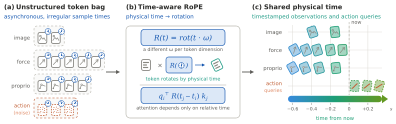
Time-aware RoPE
Each observation token uses its capture time, and each action token uses its requested execution time.
Select a token to highlight it and its corresponding representation on physical time. Select a clock to inspect its timestamp.
Temporal randomization
During training, we vary each modality’s observation rate and delivery delay, and randomize when the predicted action chunk begins. Selected measurements keep their original capture timestamps, so the policy can interpret each history even when its timing changes.
More training signal from the same demonstrations. Different resamplings can use measurements a fixed-rate grid would discard, giving the policy more views of each recorded trajectory and a wider range of timing conditions.
Real Robot Experiments
We vary observation frequency and delivery delay, inference latency, and their combination. Across Dynamic Cup, Peg Insertion, and Pivoting, Chronos Policy achieves the highest task score in every evaluated timing condition.
DP + RTC compensates for inference latency. Chronos Policy also represents observation capture times, extending robustness to changes in sensing.
Dynamic tasks: Dynamic Cup and Conveyor. Observation intervals let the policy infer object motion. Requested execution times tell it how far ahead to act when inference is delayed.
Multisensory tasks: Peg Insertion and Pivoting. Vision, proprioception, and force/torque measurements are acquired at different rates and times. Timestamps preserve their relative timing when sequence positions no longer reliably indicate when they were acquired.

When time matters most
Conveyor and Pivoting test these two timing relationships in simulation. The comparisons show all five policy variants under nominal and changed sensing and inference timing.

Ablations
Why timestamps and temporal randomization work together
Temporal randomization exposes a policy to different schedules, but without timestamps the policy cannot tell which schedule produced its inputs. Additive time encoding supplies timestamps through token features. Time-aware RoPE instead makes elapsed time part of attention while preserving token content.
The ablations compare both ingredients directly. Randomization alone helps Conveyor under moderate shifts but struggles under larger changes and on Pivoting. RoPE without randomization also loses robustness. Chronos Policy combines time-aware RoPE with temporal randomization.

Chronos Policy preserves performance when timing is less critical
Across six DexMimicGen tasks, Chronos Policy achieves comparable nominal performance to Diffusion Policy and higher average success when observation timing or inference latency changes.
DexMimicGen

Citation
If you find Chronos Policy useful in your research, please cite our work.
BibTeX
@misc{wang2026chronospolicy,
  title = {Chronos Policy: Learning Robot Policies on Physical Time},
  author = {Wang, Changhao and Clark, Jaden and Song, Shuran},
  year = {2026},
  url = {https://changhaowang.github.io/chronospolicy/}
}